

A Listening Habit Put to the Test

Most people have already adopted this behavior automatically. When faced with a very faint sound that we’re trying to hear, our first instinct is often to close our eyes to concentrate. This idea is based on an old concept that blocking out one sense sharpens another.
However, this natural instinct doesn’t work in every situation. In a busy, noisy environment, the lack of vision makes it harder to perceive important details. Far from improving concentration, closing your eyes actually leads the brain in the wrong direction.
An Experiment in the Heart of Noise
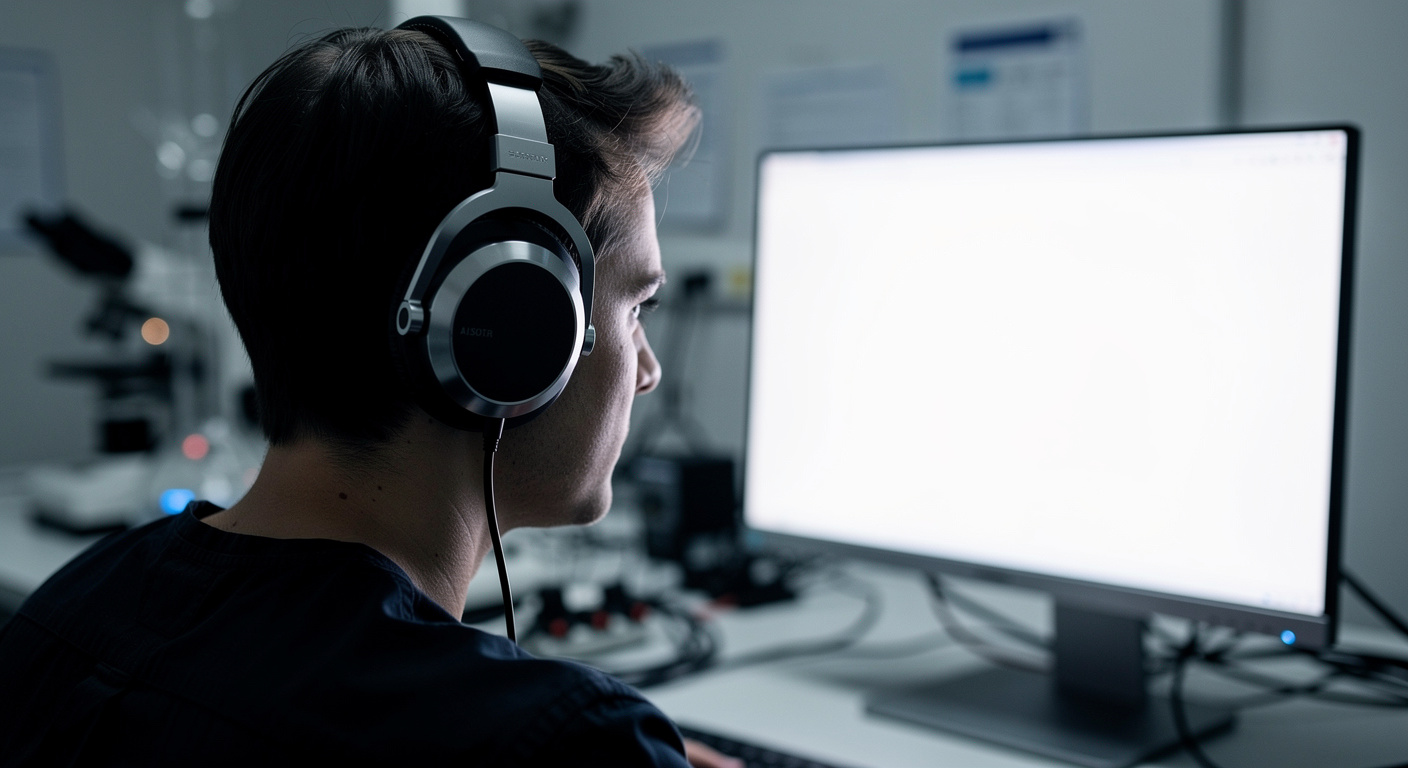
Defying Scientific Expectations
Yu Huang, an expert at the School of Mechanical Engineering at Shanghai Jiao Tong University and co-author of the study, sheds light on these observations. The data collected during the tests completely overturned scientists’ initial expectations regarding sensory perception.
“We discovered that, contrary to popular belief, closing one’s eyes actually reduces the ability to detect these sounds,” says Yu Huang. Participants had more difficulty with their vision blocked, particularly in the presence of ambient noise.
“Conversely, watching a dynamic video that corresponds to the sound significantly improves auditory sensitivity,” the researcher explains. This significant variation proves that vision and hearing work together much more closely than the general public imagines.
The Invisible Mechanisms of Brain Activity
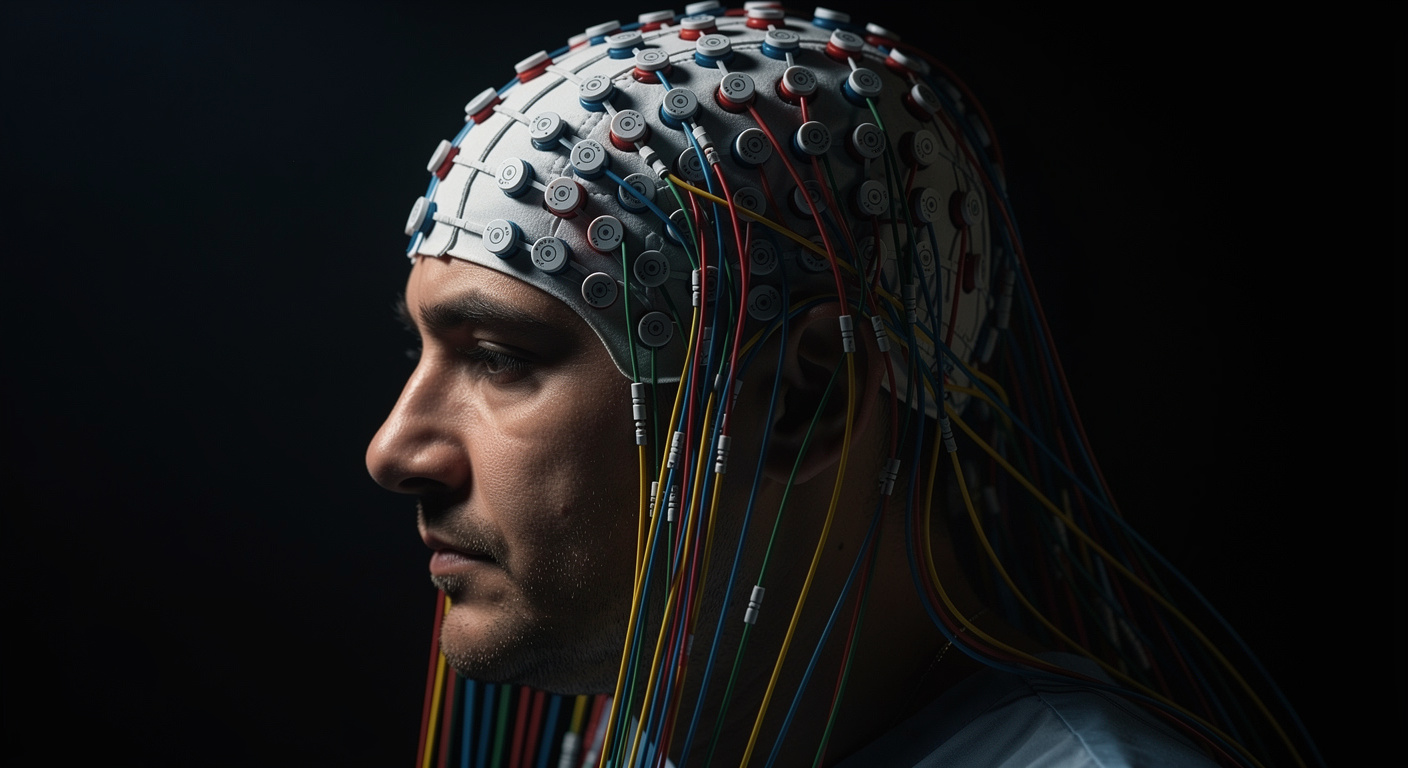
The research team used electroencephalography, or EEG, to monitor brain activity throughout the experiment. This technology allowed them to take a closer look at the brain’s internal responses when the eyes were open or closed. The transition to darkness triggers a state change known as neural criticality.
In this specific state, the brain becomes much more selective and filters incoming information more rigorously. While this mechanism seems useful, it has a major drawback: the filtering doesn’t just block background noise; it also suppresses the very sounds people are trying to hear.
“In a noisy environment, the brain must actively separate the signal from the background noise,” explains Yu Huang. “We discovered that the internal focus promoted by closing one’s eyes actually works against you in this context, leading to excessive filtering, whereas visual engagement helps anchor the auditory system to the outside world.”
The Impact of Visual Cueing

During the study, the addition of corresponding visuals made faint sounds much easier to detect, even with background noise. The brain uses these visual cues to direct attention and focus precisely on what it is listening to. In quieter environments with little background noise, however, closing one’s eyes remains useful for picking up subtle sounds.
Toward a More Nuanced Understanding of Sensory Integration

The research team plans to delve deeper into these mechanisms to understand the precise role of vision in listening. “More specifically, we want to test incongruent associations—for example, what happens if you hear a drum but see a bird?” explains Yu Huang.
“Does the visual enhancement simply come from having your eyes open and processing more visual information, or does the brain require that the visual and auditory information match perfectly? Understanding this distinction will help us separate the general effects of attention from the specific benefits of multisensory integration,” adds the specialist.
This line of research reminds us that hearing is not limited to a mechanical process involving the ears. It depends on the brain’s expectations, the elements captured by the eyes, and the way the body balances the flow of information coming from the outside world. The seemingly simple act of closing one’s eyes reveals complex neurological effects.
Source: earth.com
Closing Your Eyes to Hear Better: Why This Natural Reflex Tricks Our Brain


