

Seismic Mechanics and Tectonic Context in Southern California
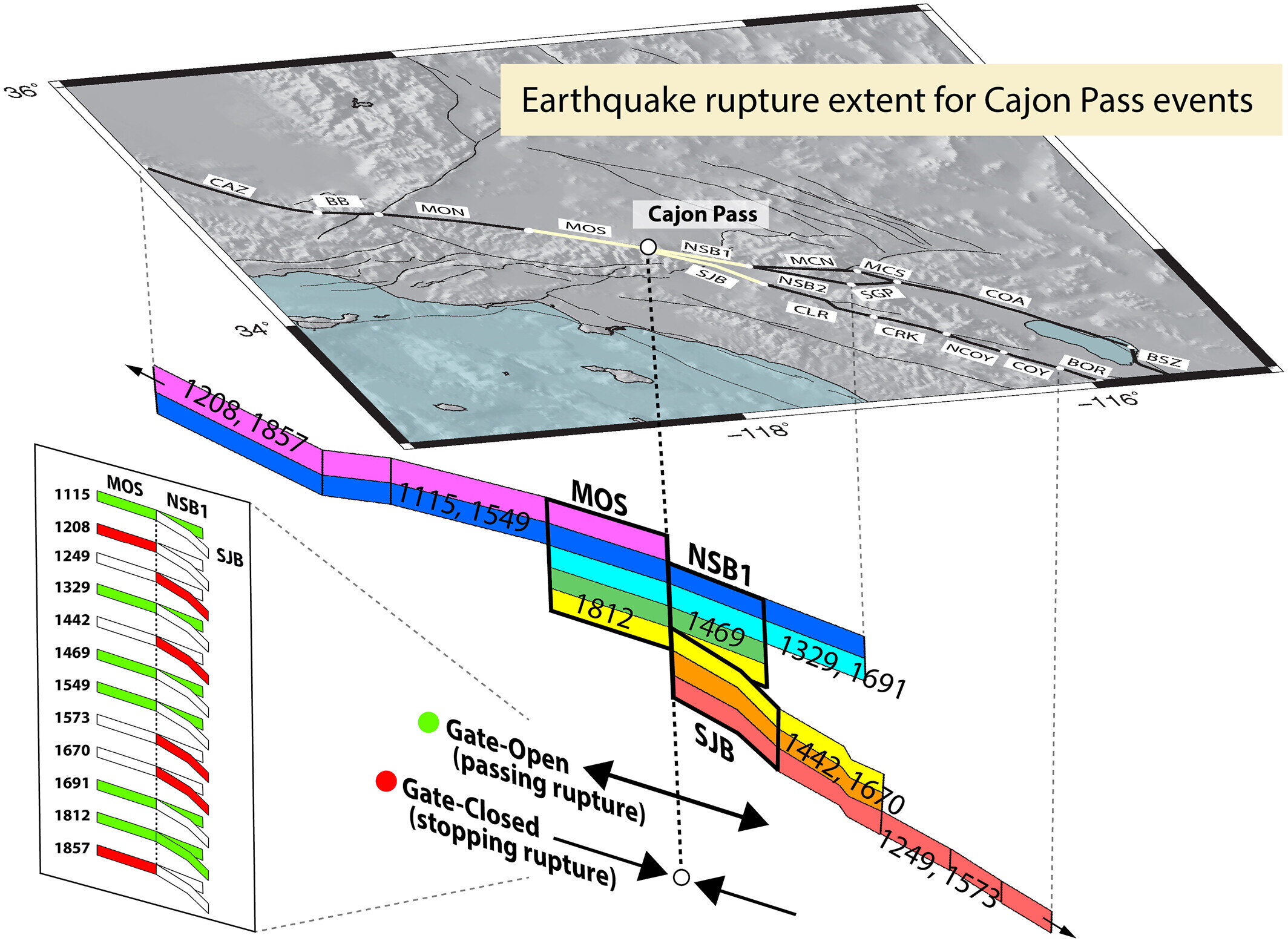
Earthquakes generally occur along fracture zones in the Earth’s crust, where large tectonic plates slide past one another and eventually become locked. Stress builds up over long periods of time and is suddenly released in the form of an earthquake. In Southern California, the San Andreas and San Jacinto faults are among the most significant zones in this dynamic, absorbing most of the plate movement in the region.
Cajon Pass, located northeast of Los Angeles, lies precisely where the two fault systems converge. It is a tectonically complex junction where a rupture on one fault could potentially propagate to the other. Since the last major earthquake to strike the greater Los Angeles area—the 1857 Fort Tejon earthquake, which had a magnitude of 7.9—tectonic stress along the fault segments has been steadily building. This prolonged period of quiet has long been a concern for researchers, given the potential for a future major rupture.
A First-of-Its-Kind Model of a Millennium of Seismic History
To assess the current state of stress, an international research team modeled 1,000 years of seismic history along the southern San Andreas and San Jacinto fault systems. This new study, recently published in the Journal of Geophysical Research: Solid Earth, was led by Dr. Liliane Burkhard of the Division of Space Research and Planetary Sciences (WP) at the Institute of Physics, University of Bern. Researchers from the University of Hawaii at Mānoa, the Seismic Science Center of the U.S. Geological Survey (USGS) in Pasadena, and the Scripps Institution of Oceanography at UC San Diego participated in the study.
To understand the temporal evolution of stress, the team constructed a physics-based four-dimensional seismic cycle model, simulating processes in three spatial dimensions and over time. This model was fed with a 1,000-year seismic record reconstructed from geological evidence such as radiocarbon dating, tree-ring anomalies, and historical records of ground ruptures. "The model tracks how each earthquake alters the stress on neighboring fault segments, how stress accumulates during quiet intervals between events, and how deeper layers of the crust slowly relax following major ruptures," explains Dr. Liliane Burkhard.
The results of this research indicate that tectonic stresses in the region have reached—and in some cases exceeded—the highest levels of the past millennium. “This simulation allows us to understand how stresses in the fault system accumulate over the centuries,” continues Dr. Liliane Burkhard. “By running the history of earthquakes in Southern California as a simulation, we can estimate the extent to which the fault system is already under stress today.”
The Concept of a Seismic Gate Applied to Cajon Pass
One of the study’s key findings is the introduction of the concept of a “seismic gate” to describe Cajon Pass. This is a junction that determines whether major ruptures remain confined to a single fault or propagate through both systems simultaneously. “The concept of a seismic gate captures something important about how fault junctions function,” explains Dr. Liliane Burkhard.
History provides examples of these two distinct behaviors. The 1857 Fort Tejon earthquake stopped at the Cajon Pass and did not involve the San Jacinto Fault. In contrast, the 1812 Wrightwood earthquake ruptured across the junction and traversed both systems in a single continuous event. “Cajon Pass neither blocks nor simply channels earthquakes: it responds to stress conditions, and these conditions change over the centuries,” adds Dr. Liliane Burkhard.
Quantified stress levels and high-risk scenarios
This situation raises serious concerns for the region. “So, not only is it concerning that stresses are reaching historic highs,” notes Dr. Liliane Burkhard, “but also that the relative stress conditions between the two fault systems are approaching the range we associate with major ruptures crossing both faults simultaneously—and that is a scenario with much more significant consequences for the region.”
Prevention, Planning, and Access to Interactive Data
The hazard assessment is based on concrete physical data but does not allow for a precise prediction of when the event will occur. “The question of when and how the next major earthquake will occur in this region is one of the most pressing issues in applied geoscience.” Our results provide a clearer, physics-based picture of the current stress state of the fault system, and the framework we have developed is applicable not only to California but also to other complex fault junctions around the world,” says Dr. Liliane Burkhard.
The researcher emphasizes, however, the model’s predictive limitations: “The study is not a prediction of when an earthquake will occur. What we can say is that the system is under critical stress and that physics-based models like ours provide a clearer picture of the range of scenarios for which we should be prepared. This information is important for risk assessment, infrastructure planning, and emergency preparedness.”
The study conducted by Liliane M. L. Burkhard and her colleagues, titled “Cajon Pass and the Southern San Andreas Fault System: Earthquake Cycle Stress Accumulation and Present-Day Loading,” was published in 2026 in the Journal of Geophysical Research: Solid Earth and is accessible via its DOI: 10.1029/2025jb033213. To complement this research, Dr. Liliane Burkhard has developed an interactive online tool called “LA-GRID” (Los Angeles Geospatial Risk and Infrastructure Dashboard). Available to both the general public and professionals, this online web tool allows users to visualize seismicity and fault-related data for the Los Angeles region, while providing real-time updates on earthquakes and wildfires.
Source: phys.org
California: Tectonic stresses reach record levels, according to a new scientific model


