Skip to content

An oceanic concert that turns into a genuine exchange
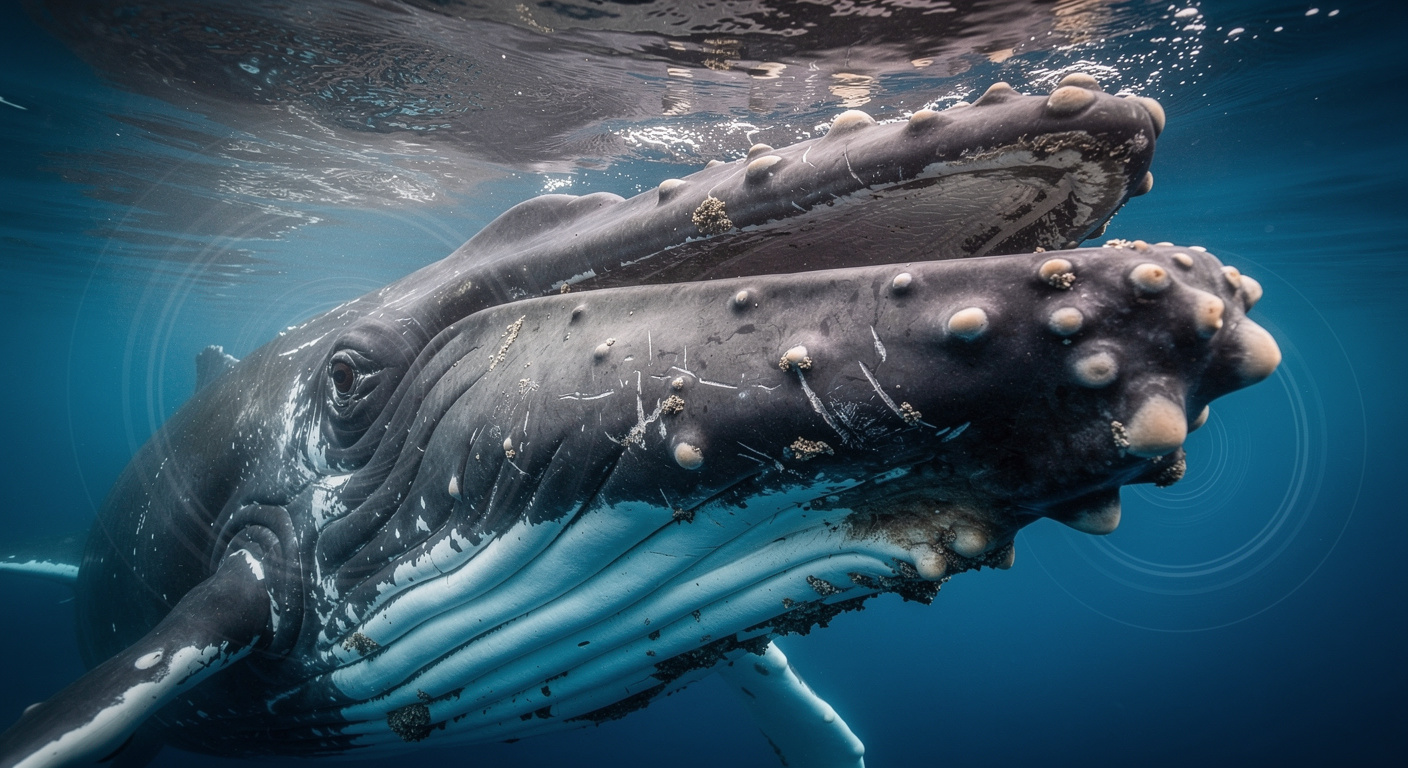
The song of the humpback whale has long been viewed as a strictly solitary performance. A new study is turning this view on its head by revealing that these impressive marine mammals adjust the pitch of their voices when another singer joins them in the surrounding waters. This discovery transforms what scientists once considered a simple monologue into a genuine real-time exchange.

The observations were conducted off the coast of Hawaii, where researchers analyzed recordings of cetaceans vocalizing alone until a second voice echoed through the water. Julia Hyland Bruno, Ph.D., a scientist at the New Jersey Institute of Technology (NJIT), led this meticulous study. She was able to demonstrate that the first singer frequently adjusted the pitch of its sounds as soon as a nearby whale became audible.

Far from being an isolated anomaly, this reaction is part of a recurring pattern identified among ten pairs of whales. Among these groups, nine of the lead singers altered their average pitch by 3 to 10 hertz. While these results prove that nearby individuals influence one another in real time, they raise a deeper question about the specific part of the song to which these animals are actually responding.

Prolonged Listening on the Ocean Floor

To capture these acoustic subtleties, the research team used a hydrophone—a microphone designed to operate underwater—placed directly on the seafloor. This device continuously recorded the sounds of the Hawaiian seafloor throughout the 2014–2015 season. The goal of the mission was not to verify whether two whales were singing identical phrases simultaneously, but rather to observe what changed when a fellow whale arrived.

The sample collected by the scientists includes 26 singing sessions, 20 of which involved pairs of whales. Some of these valuable recordings lasted nearly nine hours. This recording duration proved crucial, as clips that are too short can obscure the subtle adjustments in sound that appear, disappear, and then reappear during a single vocal exchange.

During their analysis, the researchers examined the order of the longest musical sections. They found that the duos did not overlap identical parts beyond what simple chance would predict. To reach this conclusion, they compared real pairs with artificial duos created by layering solo recordings. In this data, natural pairs overlapped about 15% of the time, a figure very close to the 16% observed in the artificially assembled solos. This finding undermines a previous report published in 2018, which suggested that nearby singers primarily competed through corresponding vocal themes.

Managing Interference and Protecting One’s Sound Space

Adjusting pitch provides whales with a valuable tool for responding when two prolonged songs overlap in the same body of water. Since sound travels very efficiently through water, one individual’s song can easily drown out another’s. This phenomenon creates acoustic interference, resulting in sounds that blend together in a confusing manner for listeners.

To circumvent this problem, the majority of co-singers responded by maintaining a pitch difference of at least ten hertz. A clear spacing pattern thus emerged in 77% of the songs analyzed. This specific behavior suggests that some whales seek to protect a small personal zone within the pitch spectrum, rather than simply singing louder to drown out their conspecifics.

Acoustic separation is only one facet of these complex dynamics. Some pairs of whales occasionally converged briefly toward the same pitch. Nine out of ten pairs exhibited converging pitches, matching notes, diverging notes, or pauses that altered the overlap of their sounds. These various reactions manifested themselves through corresponding or non-corresponding song segments, indicating that these mammals did not simply follow a predetermined script. Here, real-time listening takes precedence over the overall structure of a song, which can last for many minutes.

A rare ability in the animal kingdom

The level of adaptability observed in these cetaceans particularly impresses the scientific community due to its rarity. For Eduardo Mercado III, Ph.D., at the University at Buffalo, this unexpected flexibility is the most striking aspect of the research. "What humpback whales do is similar to what jazz musicians might do when reacting to what a bandmate is playing," explains the researcher.

The expert argues that the real surprise lies in this immediate exchange—one made up of real-time concessions and adjustments—far removed from a simple chorus or a performance that merely involves turning up the volume. The whales listen to one another, respond to each other, and adapt to one another with surgical precision.

The significance of this discovery can also be measured in terms of mammalian evolution. To date, no other mammal besides humans has been reported as capable of modulating pitch on the fly while singing. This uniqueness places humpback whales in a class of their own when it comes to animal communication.

The Social Role of Singing at Breeding Sites

These vocal interactions take on their full meaning in the context of cetacean gathering areas. Males of the species primarily use song in breeding grounds, where sound travels long distances to help the whales locate and assess one another. Understanding these mechanisms sheds light on how these giants of the sea interact.

“Studying these vocal dynamics could help us understand how these mysterious animals perceive and explore their social world,” says Julia Bruno. This approach aligns perfectly with a system in which a singer can hear its neighbors kilometers away, even when no one is within its field of vision.

Changes in pitch might therefore function more as a way to test who is nearby in the ocean, rather than simply as a display of threat toward a rival. Song becomes a tool for spatial and social exploration, allowing the animals to probe their surroundings in the vast, unseen expanse of the marine world.

Methodological limitations that open up new perspectives

Despite the scope of these observations, the study published in the scientific journal Animal Behaviour has some limitations. The researchers recorded the singers using a single stationary recorder, without being able to track the whales as they moved. This single listening point makes it impossible to determine exactly how far apart the singers were, or to know whether the same whale returned twice during the recordings.

The study’s authors deliberately focused their most precise measurements on a single type of repeated note. The other components of the song could therefore behave quite differently. These limitations underscore that the study demonstrates what humpback whales are capable of, but not yet what they typically do in their daily lives.

Future research will require the use of tracking tags, multiple recorders, or meticulous playback methods to determine with certainty which whale was the first to alter its song and for what reason. With these tools, scientists will be able to link changes in pitch to distance, movement, courtship, or pauses that may seem insignificant in a single recording. Eduardo Mercado III describes this study as a starting point rather than a conclusion, as the behavior now needs to be tracked during actual encounters. The ingenious observation made here definitively transforms the song of these cetaceans into a measurable behavior, dispelling the idea of a fixed, unchanging song and replacing it with a flexible exchange shaped by other voices. If future research confirms this pattern across different regions and seasons, science may need to rethink the underlying reasons that drive these males to sing.

Source: earth.com

The Song of the Humpback Whales: The Astonishing Discovery of Vocal Flexibility Worthy of the Greatest Duos

facebook icon twitter icon linkedin icon
Copied!

Commentaires

0 0 votes
Article Rating
Subscribe
Notify of
guest
0 Comments
Newest
Oldest Most Voted
Inline Feedbacks
View all comments
More Content