

A Historic Breakthrough in the Search for Habitable Worlds

The presence of such a gaseous envelope is fundamental to the development of biological life. As lead researcher Collin Cherubim, who recently earned his Ph.D. in Earth and Planetary Sciences at Harvard University, points out, “An atmosphere is essential for a planet to support life as we know it.” He adds that this is “the first time an atmosphere has been discovered on a rocky planet located in the habitable zone of another star.”
Profile of the rocky exoplanet LHS 1140 b
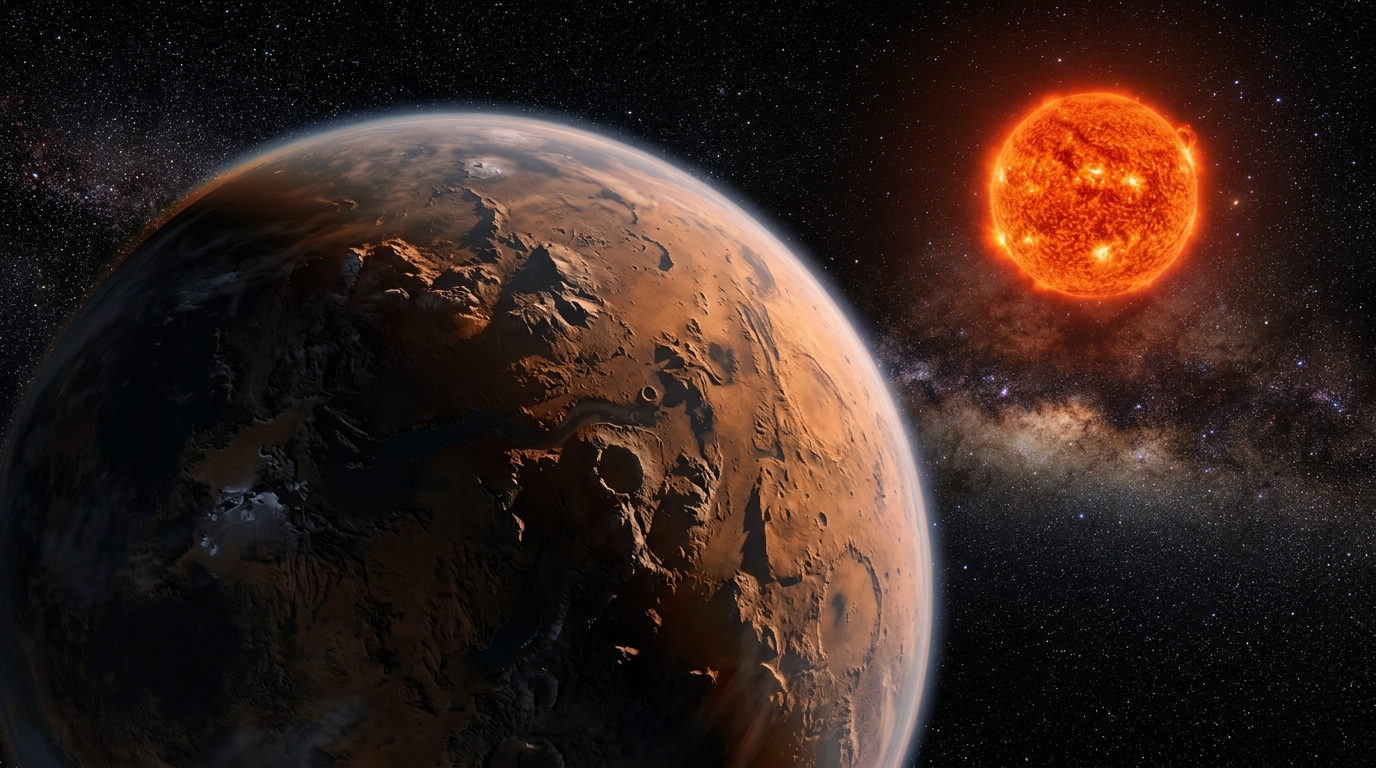
The planet at the heart of this discovery, named LHS 1140 b, is a rocky world located about 48 light-years from Earth. It orbits a red dwarf star, remaining within its habitable zone. This specific orbital region features moderate temperatures and environmental conditions, compatible with the presence of liquid water on the planet’s surface.
This helium leak confirms that the exoplanet has possessed and retained an atmosphere for an extremely long period of time. According to astronomers’ estimates, this atmosphere has withstood stellar winds and radiation for more than three billion years, making it an invaluable natural laboratory for future astrophysical studies.
From Mathematical Prediction to Observational Evidence

David Charbonneau, Cherubim’s co-advisor, chair of Harvard’s Department of Astronomy, and a researcher at the Center for Astrophysics | Harvard & Smithsonian, admitted that he had initially approached the project with caution. In his view, deriving such a prediction from theoretical calculations had never before been empirically validated for a rocky exoplanet.
However, analysis of the observational data quickly dispelled the initial doubts. David Charbonneau explains the young researcher’s success as follows: “Collin analyzed the planets we knew about and predicted that this one would have a helium atmosphere. Then he secured observing time on the telescope, obtained the data, and the detection turned out to be statistically rock-solid.”
The observation method using the Magellan telescope in Chile

New Perspectives for the Search for Extraterrestrial Life

This achievement marks a major technological breakthrough in deep-space exploration. As Robin Wordsworth, a professor of environmental science and engineering and Earth and planetary sciences at Harvard, points out, research has made spectacular strides: “Twenty years ago, we were wondering if other Earth-like planets even existed. Then we learned that they were common, and we found some in the habitable zone. The next question was whether any of them had managed to retain an atmosphere. Now we know that at least one of them has succeeded.”
This successful methodological validation paves the way for other exciting discoveries. Building on this proven model, the research team plans to explore other star systems in search of twin worlds. As Collin Cherubim concludes, “This work has validated the model, and we hope this is just the first in a long series of observations to come.”
Source: phys.org
Historic Discovery: An Atmosphere Detected on a Rocky Planet in the Habitable Zone Outside Our Solar System


