

The Physics of Waves: Constant Light and Capricious Sound
On Earth, as in the rest of the universe, certain physical laws seem immutable. The speed of light in a vacuum is one of the most reliable benchmarks in the cosmos, traveling at exactly 299,792,458 meters per second. Even when it passes through an atmosphere and slows down very slightly as it interacts with air molecules, its speed remains virtually the same, whether you’re on our planet or on the Red Planet.
A groundbreaking experiment conducted by the Perseverance rover
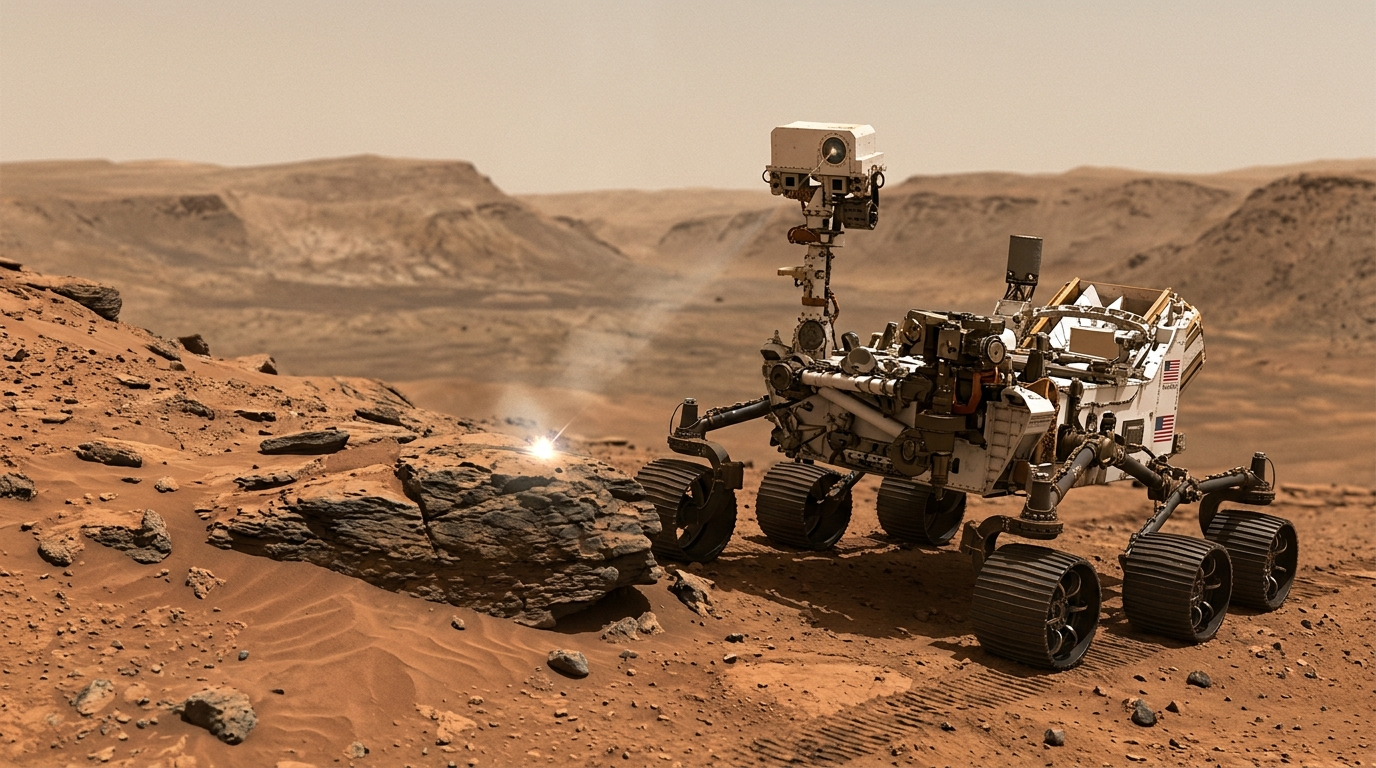
In 2022, an international team of scientists set out to systematically analyze sound propagation on Mars using NASA’s Perseverance rover. This study made it possible to measure the speed of sound on a planet other than Earth for the very first time, revealing particularly unusual acoustic behavior, as reported by IFLScience.
To take these measurements in Jezero Crater, the scientists used a direct method. They fired a laser at rocks located at known distances, then measured the time it took for the shock wave to reach the rover’s microphones. The experiment established an average speed of sound of 240 meters per second, or about 864 kilometers per hour.
Marked diurnal temperature variations

Measurements taken on Mars also revealed a fluctuation in the speed of sound of about 10% between day and night. This phenomenon is explained by the large temperature variations observed on the planet’s surface—a property also observed on Earth under extreme weather conditions.
A Unique Phenomenon: Two Speeds of Sound in the Audible Spectrum
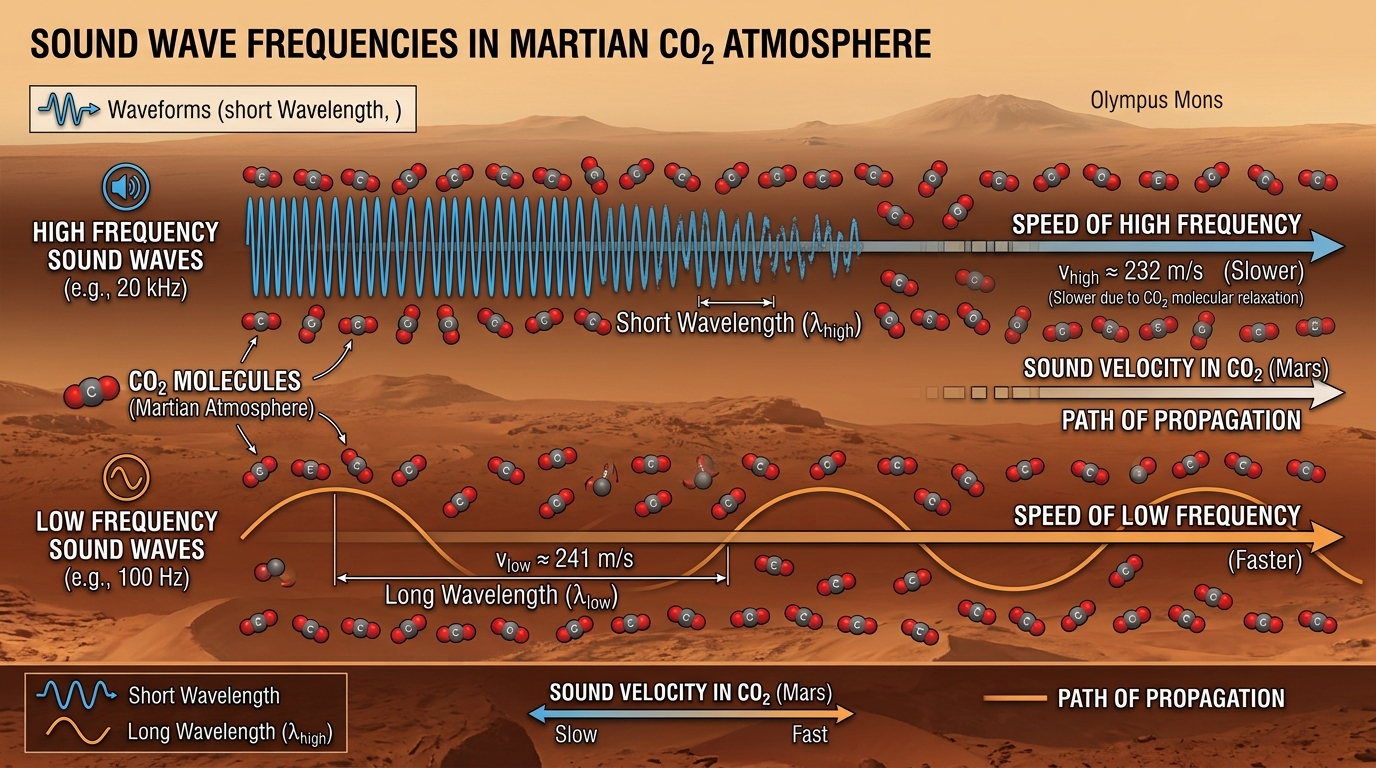
According to the explanations provided in the study presented at the 53rd Lunar and Planetary Science Conference: “Due to the unique properties of carbon dioxide molecules at low pressure, Mars is the only terrestrial planet in the Solar System whose atmosphere experiences a change in the speed of sound right in the middle of the audible frequency range (20 Hz–20 kHz).”
The researchers note that “for an acoustic wave with a frequency higher than about 240 Hz [just below middle C on a piano], the vibration modes of CO₂ activated by collisions do not have time to release their energy.” It turns out that, on Mars, frequencies above 240 Hz travel more than 10 meters per second faster than lower frequencies. High-pitched sounds travel at 250 meters per second, compared to 240 meters per second for low-pitched sounds, which means that high-pitched sounds reach the listener before low-pitched ones.
Extreme sound attenuation and a hostile environment

An official statement from NASA’s Jet Propulsion Laboratory explains this difference: “On Earth, sound may fade after about 65 meters (213 feet); on Mars, it fades as early as 8 meters (26 feet), with high-pitched sounds being completely lost at that distance.”
This combination of factors would make any concert or musical gathering completely impractical on the Red Planet—not to mention the crowds capable of triggering seismic sensors during massive concerts held on Earth. Between the freezing cold, the thin atmosphere, and significant acoustic distortion, music on Mars is decidedly impossible.
Source: iflscience.com
How Sound Travels on Mars and Why the Acoustics of the Red Planet Are So Unique


