

The Mystery of the First Sea Crossings
A Chronology Pushed Back by Genetics and Archaeology

Evidence of ancient occupation of island regions has accumulated in recent years. According to a large-scale genetic analysis published in the journal Science Advances in late 2025, human populations settled on the paleocontinent of Sahul—which encompassed present-day Australia and New Guinea—approximately 60,000 years ago.
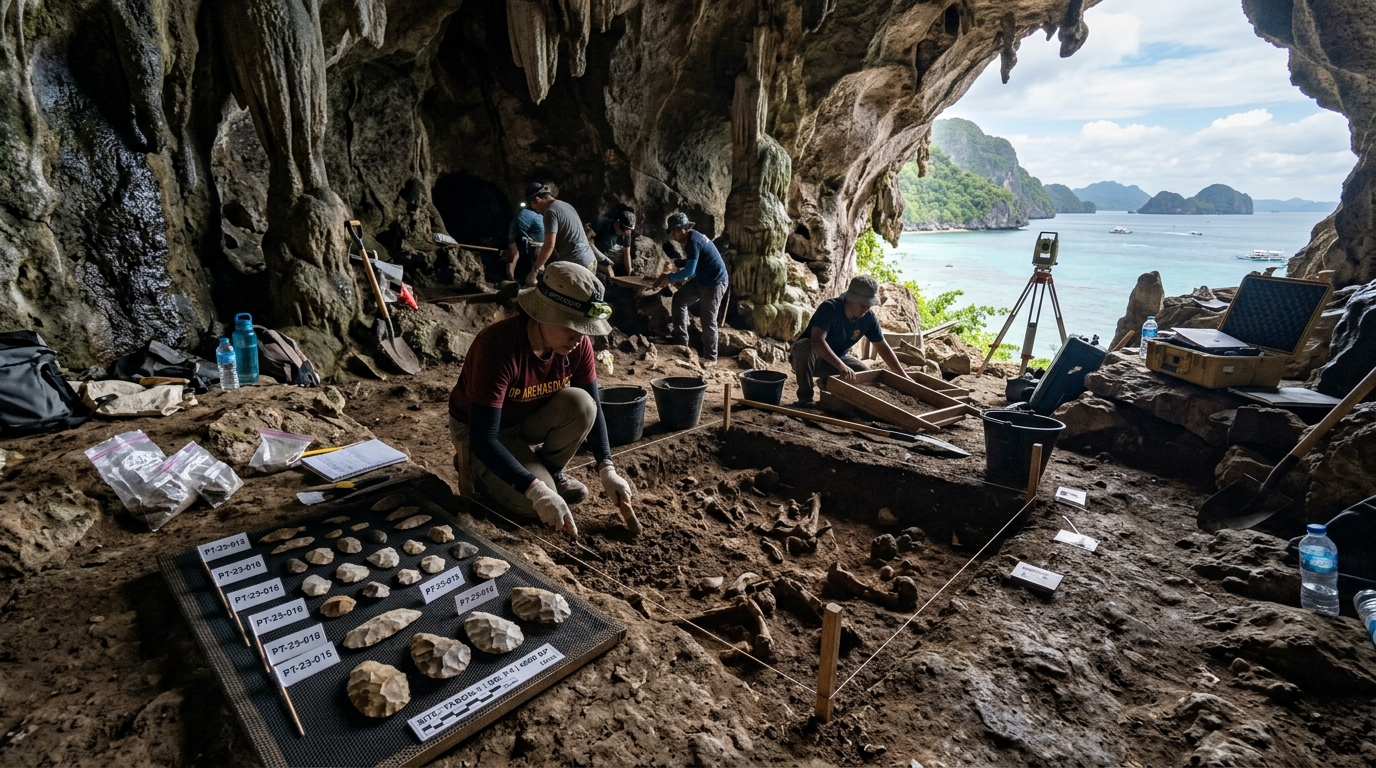
Microscopic analysis of stone tools

The scientists assert that these marks indicate “the extraction of fibers needed to make ropes, nets, and ties essential for shipbuilding and deep-sea fishing.” This mastery of rope-making was a fundamental step in the construction of sturdy boats.
Deep-sea fishing and the management of marine resources

As the study’s authors noted: “The remains of large predatory pelagic fish at these sites indicate an advanced ability to navigate the open ocean and a knowledge of the seasonality and migratory routes of these fish species.” They note that all of these artifacts “indicate the need for strong, well-designed rope for fishing lines and nets to catch marine life.”
Prehistoric ingenuity with lasting implications

The study’s authors, however, point out the inherent limitations of the available evidence. In early 2026, co-author Alfred Pawlik publicly stated that there is no direct material evidence revealing the exact appearance of these 40,000-year-old vessels. The transition from processing plant fibers to building ligature-bound boats remains a very strong hypothesis, but not a formally preserved blueprint.
Nevertheless, the significance of these discoveries remains substantial. The researchers note that “the identification of shipbuilding materials through direct or indirect evidence is essential for understanding movement across and within island environments.” In a press release from Ateneo de Manila University, they add: “The presence of such advanced maritime technology in prehistoric insular Southeast Asia underscores the ingenuity of the ancient Filipino peoples and their neighbors, whose knowledge of shipbuilding likely made the region a hub of technological innovation tens of thousands of years ago and laid the foundation for the maritime traditions that still thrive in the region today.”
Source: popularmechanics.com
Ancient tools challenge the chronology of prehistoric navigation


