

The Enduring Mystery of Cosmic Silence

Since that initial question was posed, numerous hypotheses have emerged. Some are meant to be reassuring, while others are downright terrifying. A popular theory, known as the Dark Forest, suggests a universe where a great silence reigns because every civilization is too afraid of the others to make contact, fearing it would lead to its own destruction. Other, less sinister explanations suggest that these distant societies are stranded and isolated on their home planets, unable to explore the cosmos, leave their own atmospheres, or develop advanced technology. It is also theorized that civilizations are simply too far apart from one another—both in space and time—to successfully communicate.
Methods for Tracking Advanced Civilizations

The search for extraterrestrial life is organized around several specific approaches. Scientists first look for potential megastructures designed by advanced civilizations to harness the energy of their stars. It’s worth noting that Freeman Dyson, known for his famous Dyson sphere, originally suggested the idea only as a joke.
The Strategic Choice of a Narrow Band

SETI’s Breakthrough Listen project explains the underlying logic: “We cannot be sure that extraterrestrial civilizations will choose to transmit narrowband signals, or even that they will use radio or laser communications, but if they are deliberately trying to attract attention, a narrowband radio or laser signal is an excellent way to do so.” Concentrating energy on a narrow frequency would optimize the message’s range and visibility.
Experts from the same project add a crucial detail about the resilience of these waves: “Both are capable of traveling interstellar and even intergalactic distances, and tend to stand out from the background noise of natural signals mainly because they cover only a narrow range of frequencies.” It is on this theoretical basis that ground-based detection equipment has been calibrated.
The disruptive role of the stellar environment

The recent study challenges this well-established approach. The researchers point to a natural phenomenon capable of scrambling these targeted messages. The team sought to investigate how the exoplanetary interplanetary medium (Exo-IPM) of an extraterrestrial civilization—that is, the space surrounding its star—might affect the signals it sends out into the cosmos. Stars are far from being calm celestial bodies.
The scientists wanted to verify whether violent events, such as stellar winds and coronal mass ejections, could broaden these famous narrowband signals—which are vital for communication over incredibly long distances. Vishal Gajjar, an astronomer at the SETI Institute and lead author of the paper, elaborated on this issue in an official statement: “SETI research is often optimized for extremely narrow signals,” the researcher noted.
This environmental disturbance has a direct impact on our ability to receive signals on Earth. The scientist continues: “If a signal is broadened by the environment of its own star, it may slip below our detection thresholds, even if it is present, which potentially helps explain some of the radio silence we have observed in the search for technosignatures.” The message could therefore very well be reaching us, but in a form that has become undetectable by our current instruments.
Revealing Tests in Our Solar System and Beyond
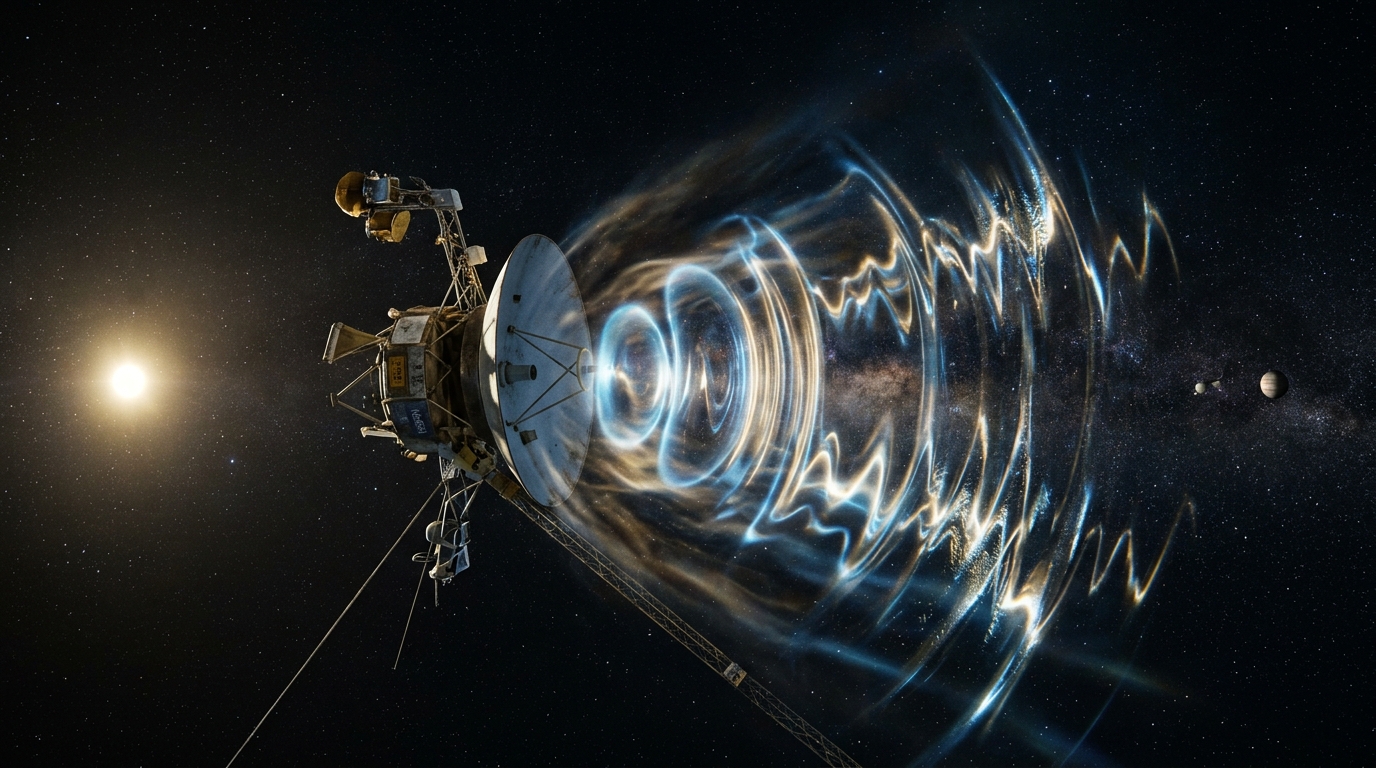
To test this hypothesis, the researchers first analyzed our own historical narrowband signals. They studied communications sent by spacecraft throughout our solar system and relayed back to Earth. The team was able to quantify the spectral broadening experienced by these waves, noting that the problem worsened considerably during the solar maximum—the period when the Sun is much more active.
The study’s authors detail the extent of the phenomenon: “We show that broadening can exceed 10–100 Hz for most systems. These levels of spectral broadening are significant enough to shift otherwise detectable technosignatures below the sensitivity thresholds of current research pipelines optimized for sub-hertz channels.” The team concludes with certainty: “These results suggest that turbulence-induced spectral broadening—particularly in the dynamic environments of dMs—may offer a compelling explanation for the apparent absence of detected narrowband radio technosignatures.”
Rethinking the Search for the Future

Grayce C. Brown, co-author of the study and a research assistant at the SETI Institute, offers an optimistic perspective on this work. According to her, this discovery allows us to adapt our strategies. “By quantifying how stellar activity can reshape narrowband signals, we can design searches that better match what’s actually happening on Earth,” the scientist emphasizes.
The goal is no longer to search for a perfect signal, but to anticipate how it will be altered during its interstellar journey. The researcher concludes by noting that we must focus “not only on what might be transmitted.” This major shift will require detection algorithms to account for noise and distortion in order to finally break the great silence of the universe.
Source: iflscience.com
SETI may have figured out why we haven’t detected any extraterrestrial signals yet, shedding light on part of the Fermi paradox


